
The issue that catches most L5P owners off guard: the CAN bus architecture changed in 2020. The plugs that work on a 2017–2019 L5P will not work correctly on a 2020–2023 L5P, and vice versa. The difference isn’t cosmetic. It’s a wiring-level architectural change inside the truck’s communication network that, if ignored, causes the fuel gauge to drop to zero, the lift pump status to vanish, and the ECM to potentially derate the engine because it can’t confirm the fuel system is alive.
This guide covers everything: how the L5P CAN bus actually works, how to diagnose CAN bus-related problems after a delete and which IFJF plugs fit your specific model year. If you’re planning an L5P delete or troubleshooting one that isn’t running right, this is the resource.
How the L5P CAN Bus Actually Works
The Protocol
CAN bus — Controller Area Network — is a two-wire serial communication protocol that lets every electronic module in the truck transmit and receive data without a central controller. The two wires are CAN High (CAN_H) and CAN Low (CAN_L), twisted together along the entire length of the harness to reject electromagnetic interference. At each end of the bus, a 120-ohm terminating resistor bridges CAN_H and CAN_L, creating a 60-ohm total bus resistance. These resistors prevent signal reflection — without them, the digital signal echoes back along the wire, corrupting data packets that arrive microseconds later.
The CAN bus plug’s job is straightforward: terminate the NOx sensor connectors and the DEF module connector, close the signal circuit, and provide a stable acknowledgement back to the ECM.
The L5P Network Topology
The L5P’s CAN bus isn’t one single wire snaking through the truck. It’s segmented into multiple bus branches, each serving specific groups of modules. The primary segments include:
-
Powertrain CAN: ECM, TCM, throttle pedal position sensor, turbocharger actuator. High-speed, high-criticality — this is the segment where a communication failure triggers immediate limp mode.
-
Chassis CAN: ABS module, trailer brake controller, steering angle sensor, suspension control. Moderately critical — failures affect safety systems but typically don’t derate the engine.
-
Body CAN: Instrument cluster, HVAC, door modules, seat modules, infotainment. Low criticality — failures are annoying but not dangerous.
-
Aftertreatment CAN: NOx sensors (up to three on the L5P, depending on configuration), DEF tank module, DEF injector, DPF differential pressure sensor, exhaust temperature sensors. This is the segment that contains the modules removed during a delete.
Why CAN Bus Plugs Exist in the First Place
When you unplug a NOx sensor during a delete, you’re not just removing a sensor. You’re removing a node from the CAN bus — a module that the ECM polls every 10 to 100 milliseconds, expecting a valid response. On an electronic network where every packet is acknowledged, silence is an error.
The ECM’s response to a missing module follows an escalation path:
-
Immediate: The ECM logs a U-code (network communication code) — typically U010E for lost communication with NOx sensor 1, U010F for NOx sensor 2, or U029D for lost communication with the DEF module.
-
Within seconds to minutes: If the missing module is on a critical bus segment, or if the ECM determines the missing data compromises emissions compliance, it illuminates the check engine light.
-
Within minutes to hours: If the ECM relies on data from the missing module for engine protection logic — for example, exhaust temperature readings used to manage turbocharger cooling — it may enter a reduced-power derate, limiting engine output to prevent potential damage.
-
Cascading effects: On the 2020+ L5P, where the aftertreatment and fuel tank modules share a bus segment, a missing NOx module can take down the entire segment, causing the ECM to lose fuel tank data. This isn’t a communication error limited to one module. It’s a segment-level failure.
CAN bus plugs exist to prevent every step of this cascade. They impersonate the missing modules at the electrical level — not by generating fake sensor data (that’s the tuner’s job), but by maintaining the bus segment’s electrical integrity so that the modules that are still installed can continue communicating without interference from the modules that were removed.
Pre-2020 vs. 2020+: What Changed in the L5P CAN Bus Architecture
On the 2017–2019 L5P, the NOx sensors and DEF module sit on a dedicated aftertreatment CAN bus segment that communicates exclusively with the ECM and the exhaust aftertreatment control module. The fuel tank level sensor and lift pump run on a separate powertrain CAN segment that is completely unaffected by aftertreatment module removal. Removing the NOx sensors electrically isolates the aftertreatment segment. Nothing else goes down.
Can Bus Plugs | 2017-2019 GM/Chevy Duramax L5P
The Can Bus Plugs for 2017–2019 Duramax L5P are engineered specifically for the pre-2020 L5P electrical architecture. No active electronics, no signal generation, no software timing that can drift or fail. A properly engineered termination circuit in a sealed, vibration-rated housing.

Key features:
- ABS housing, moisture-sealed — the plug bodies are molded from impact-resistant ABS that withstands under-hood temperatures from -40°F cold-soak to 250°F+ sustained heat, vibration from 6.6L diesel harmonics, and chemical exposure.
- Designed for use with aftermarket exhaust systems — when the factory DPF, SCR catalyst, and associated NOx sensors are removed and replaced with a delete pipe, these plugs connect to the now-empty sensor harness connectors and maintain CAN bus integrity.
- Replaces NOx and DEF module connectors on the CAN bus — each plug closes the circuit at the connector it replaces, presenting the correct impedance and signal characteristics to the ECM.
- Looped wire design with controlled impedance — the internal wiring creates a stable, predictable circuit that the ECM interprets as a functioning node. Unlike passive resistor-based terminators, the looped wire design doesn’t drift with temperature, doesn’t corrode at solder joints, and doesn’t introduce bus noise from impedance mismatch.
Best for: 2017–2019 L5P owners performing a DPF/DEF delete who need CAN bus plugs that correctly terminate the pre-2020 NOx/DEF bus segment without interfering with other vehicle systems.
2020–2023 L5P: The Integrated Bus Architecture
For the 2020 model year, GM revised the L5P’s electrical architecture as part of the Global B platform transition. The most significant change for delete applications: the aftertreatment CAN bus segment was integrated with the fuel tank telemetry bus. The NOx sensors, DEF module, fuel tank level sensor, fuel temperature sensor, and lift pump controller now share a single CAN bus segment.
The practical consequence: removing the NOx sensors and DEF module without preserving the bus segment’s continuity also removes the fuel tank module from the network. The ECM doesn’t just lose NOx data. It loses fuel level. Fuel temperature. Lift pump status. The fuel gauge drops to zero or freezes at its last known value. The DTE (distance-to-empty) calculation fails. The ECM, unable to confirm the lift pump is operating, may trigger a P0087 (low fuel rail pressure) derate.
Can Bus Plugs | 2020-2023 GM/Chevy Duramax L5P
The IFJF Can Bus Plugs for 2020–2023 GM/Chevy Duramax L5P are engineered for the revised 2020+ electrical architecture, where the NOx/DEF bus segment is integrated with the fuel tank telemetry bus. These plugs don’t just terminate the sensor connectors — they preserve the communication path to the fuel tank module so the ECM continues receiving fuel level, fuel temperature, and lift pump status data.

Key features:
- Designed for aftermarket exhaust systems and delete pipes — physically replaces the NOx sensor and DEF module connectors after the factory emissions components are removed.
- Provides a closed signal back to the ECM for proper operation — the internal circuit closes the signal loop and delivers a stable, predictable bus response that the ECM interprets as normal module presence.
- Keeps the CAN-BUS alive to the fuel tank — on the 2020+ L5P, the fuel tank module shares a bus segment with the NOx/DEF modules. The IFJF 2020+ plugs maintain that bus segment’s continuity to the fuel tank, ensuring the ECM continues receiving fuel level. The truck does not enter a reduced-power mode from lost fuel system telemetry.
- Maintains normal ECU operation for fuel tank and lift pump data — Interrupt that data, and the ECM defaults to safe-mode assumptions that can include reduced fuel delivery. These plugs prevent that cascade entirely.
Best for: 2020–2023 L5P owners who need CAN bus plugs that address the integrated bus architecture — maintaining fuel tank communication while terminating the NOx/DEF nodes.
Diagnostic Guide: What Your Truck Is Telling You
After completing a delete, CAN bus-related symptoms follow predictable patterns. Here’s how to translate what the truck is showing you into what’s wrong:
Symptom 1: Fuel Gauge Drops to Zero Immediately After Delete (2020+ Trucks)
What’s happening: The most definitive sign that pre-2020 CAN bus plugs were installed on a 2020+ truck. The fuel tank module is on the same bus segment as the NOx/DEF modules, and the plugs didn’t preserve the path to the tank. The ECM lost communication with the fuel tank module.
What to do: Replace the plugs with the IFJF 2020–2023 CAN bus plugs. The problem will resolve immediately — no re-tuning, no sensor replacement, no fuel pump diagnosis. The bus segment restores communication, the data returns, and the gauge comes back online.
Symptom 2: Intermittent Fuel Gauge Dropout (2020+ Trucks)
What’s happening: The CAN bus plug is making marginal contact — either the connector isn’t fully seated, or moisture has entered the connector and is creating intermittent resistance on the bus.
What to do: Inspect every CAN bus plug connector. Confirm the latches are fully engaged. Check the connector seals for deformation or moisture ingress. Apply dielectric grease to the connector seals if operating in wet or salted conditions. Replace any plug that shows signs of corrosion or seal damage.
Symptom 3: U010E / U010F / U029D Codes After Delete
What’s happening: The ECM is logging a communication loss code for a NOx sensor or DEF module. Either the CAN bus plug for that specific connector isn’t installed, isn’t fully seated, or has an internal wiring fault. The ECM polls the connector and gets no response.
What to do: Verify the CAN bus plug is installed on the connector corresponding to the code.
- U010E = NOx sensor 1 (upstream)
- U010F = NOx sensor 2 (downstream)
- U029D = DEF module
Trace the harness to confirm the correct connector is terminated. Re-seat the plug and clear codes. If the code returns, replace the plug.
Symptom 4: P0087 Low Fuel Rail Pressure (2020+ Truck)
What’s happening: This is the cascade outcome of the wrong CAN bus plugs. The ECM lost communication with the lift pump controller when the fuel tank bus segment went down. Unable to confirm the lift pump is delivering fuel, the ECM triggers a low fuel pressure code and may derate the engine — even though the lift pump is physically operating normally.
What to do: This code is a symptom, not the cause. Do not replace the lift pump. Replace the CAN bus plugs with the correct 2020–2023 version. Clear codes. The ECM will re-establish communication with the fuel tank module, confirm lift pump status, and clear the derate condition.
Symptom 5: Multiple Random U-Codes Across Unrelated Modules
What’s happening: A CAN bus plug is introducing noise onto the bus — typically from a failed internal connection, moisture-induced resistance, or a DIY resistor-based terminator that’s drifting out of spec. The noise corrupts data packets from modules that have nothing to do with the aftertreatment system: ABS, transmission, instrument cluster.
What to do: This is the most difficult CAN bus problem to diagnose because the codes don’t point to the root cause. Disconnect the CAN bus plugs one at a time, clear codes, and restart. If the random U-codes disappear when a specific plug is disconnected, that plug is the source of bus noise. Replace it.
3.5" Downpipe | 5" DPF pipe | EGR Delete | 2017-2019 GM/Chevy Duramax L5P 6.6L
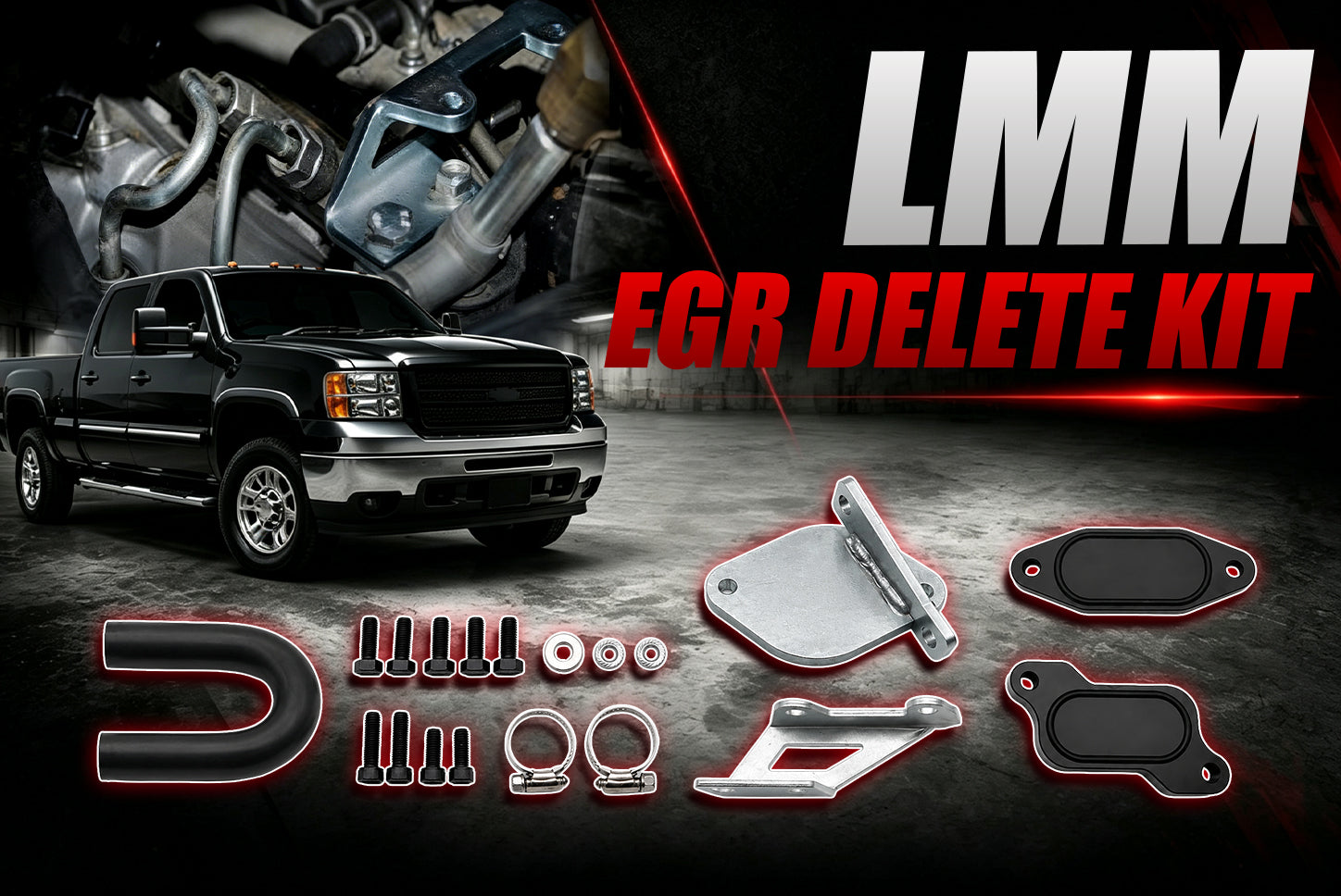
For 2017–2019 L5P owners who want a single, complete solution — not three separate orders from three different vendors — the 3.5" Downpipe | 5" DPF Pipe | EGR Delete | CAN Bus Plugs Kit bundles every delete component into one package. Each component uses the right material for its function, and every part is engineered to bolt on without permanent modification to the truck.

Material
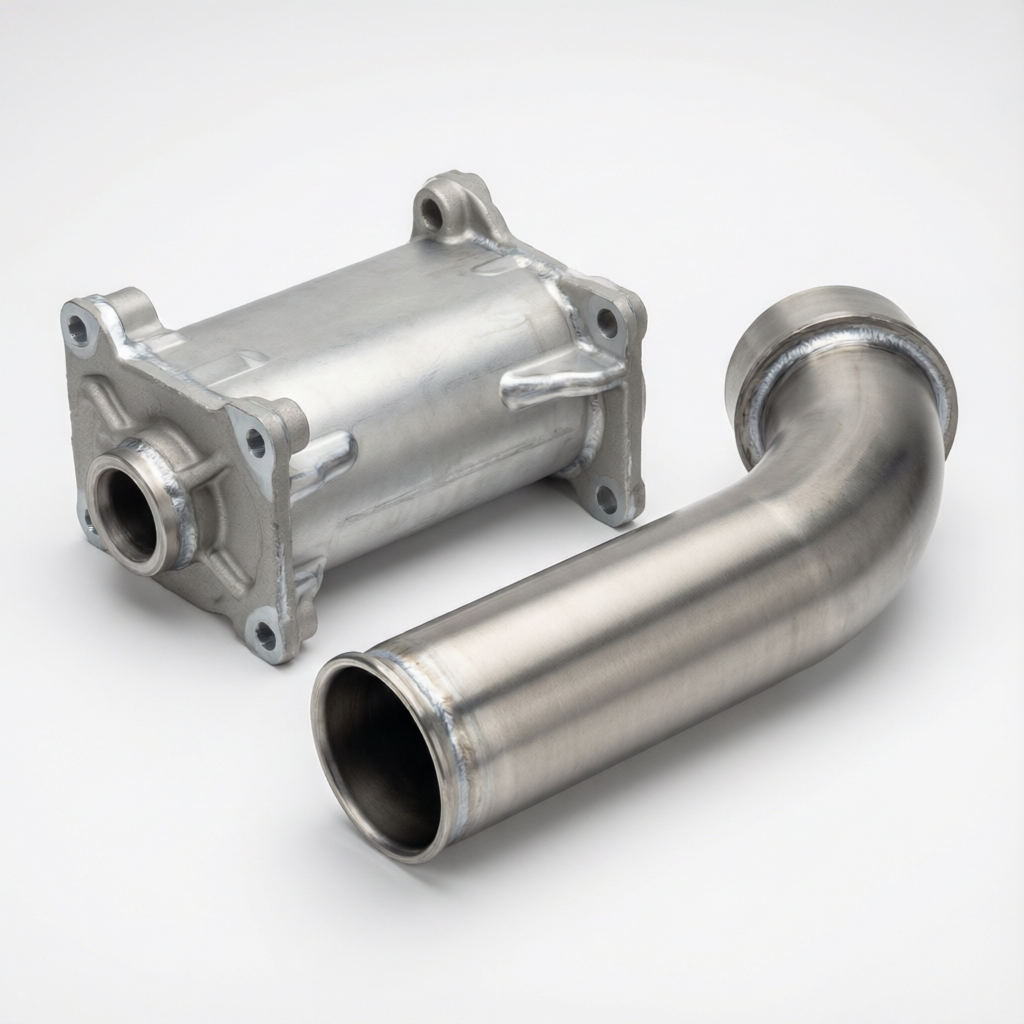
- The 5-inch DPF delete pipe and 3.5-inch downpipe are fabricated from heavy-gauge T-409 stainless steel, mandrel-formed for consistent internal diameter with no crush points or necking at the bends.
- The EGR block-off plates are CNC-machined from billet aluminum alloy for a precise, leak-free seal at the exhaust manifold and intake manifold ports.
- The CAN bus plugs use silicone-sealed ABS housings for moisture resistance and long-term electrical integrity.
5-inch DPF pipe & 3.5-inch downpipe
The combination removes the two largest exhaust restrictions on the L5P, dropping backpressure to near-zero. Lower EGTs under sustained heavy towing, measurably faster turbo spool, and a deep, unrestricted exhaust note that sounds like a 6.6L V8 turbo-diesel should.
CAN bus plugs with looped wire closed signal
The included CAN bus plugs terminate the NOx and DEF module connectors with stable, controlled-impedance looped circuits. The ECM sees valid nodes, communication errors don’t appear, and the pre-2020 bus segment stays electrically intact.
Better cooling system longevity
The combination lowers sustained engine coolant temperatures, reduces under-hood heat soak, and extends the service life of every heat-sensitive component: radiator, coolant hoses, serpentine belt, alternator, and wiring harness.
Complete bolt-on design
Every component in the kit installs using factory mounting points and flange connections. No cutting, no welding, no drilling. The factory exhaust, EGR cooler, EGR valve, NOx sensors, and DEF module are removed and can be stored for reinstallation. The kit is intended for off-road and competition use.
Best for: 2017–2019 L5P owners who want the complete delete in one box — downpipe, DPF pipe, EGR delete plates, and correct CAN bus plugs — with no separate orders, no compatibility guesswork, and no missing components discovered mid-install.
Installation Guide
What You Need
- Vehicle-specific IFJF CAN bus plugs (2017–2019 or 2020–2023)
- Delete tune loaded on your ECM via compatible tuner
- Factory NOx sensors and DEF module physically removed from the exhaust system
- Clean workspace, flashlight, and zip ties for harness management
Step-by-Step
1. Complete the physical delete first. Install the DPF delete pipe, remove the NOx sensors from the exhaust, disconnect the DEF module, and install the EGR delete kit. The CAN bus plugs are installed after the sensors are removed — they connect to the harness-side connectors that the sensors were plugged into, not to the sensors themselves.
2. Identify the harness connectors. The L5P has two or three NOx sensor connectors depending on configuration, plus the DEF module connector. Trace the wiring from each removed sensor back to its harness connector. The connectors are keyed and color-coded — they only mate one way.
3. Inspect every connector before plugging in. Look for bent pins, corrosion, debris, or moisture in the connector cavity. A contaminated connector will cause bus communication problems regardless of the plug quality. Clean with electrical contact cleaner and compressed air if necessary. Let dry completely before installing the plug.
4. Install the CAN bus plugs. Insert each plug into its corresponding harness connector until the latch audibly clicks. Tug gently on the plug to confirm it’s fully seated — a partially seated connector will cause intermittent communication failures, and those are the hardest problems to diagnose.
5. Apply dielectric grease to the connector seals if the truck operates in wet, salted, or high-humidity conditions. The grease creates an additional moisture barrier at the seal interface without affecting the electrical connection.
6. Secure the connectors. Use zip ties or factory harness clips to secure each plug and its adjacent wiring to the harness. Unsupported plugs vibrate against the engine, the frame, or each other, causing connector wear, seal deformation, and eventual contact failure. A plug rattling against a metal bracket at 2,000 RPM will fail — support it.
7. Load the delete tune. Flash the tuned calibration to the ECM using your tuning device. The tune disables NOx, DEF, DPF, and EGR diagnostic routines in the ECM’s software.
8. Verify operation. Start the engine. Confirm the check engine light is off. Confirm the fuel gauge reads correctly (critical for 2020+ trucks). Confirm no U-codes or P-codes are present on a scan tool. Road-test the truck through a full drive cycle — idle, part-throttle cruise, wide-open throttle — and re-scan for codes.
Note on 2020+ installations: Immediately after installing CAN bus plugs on a 2020+ truck, check the fuel gauge, DTE display, and — if your scan tool supports it — the lift pump status PID. If any of these are not reading correctly, the wrong plugs were likely installed (pre-2020 version on a 2020+ truck). The fuel gauge dropping to zero is the definitive sign.
Conclusion
The L5P Duramax is the most electronically sophisticated diesel platform GM has ever built — and the CAN bus is its central nervous system. When you remove emissions components from that nervous system, the modules that remain must still be able to communicate. CAN bus plugs are the bridge between what was removed and what stays.
The 2020 architecture change is not a minor revision. It changed the bus topology at the wiring level, and using the wrong plugs on a 2020+ truck causes a cascade of fuel system failures that are expensive to misdiagnose and impossible to resolve without the correct parts.
CAN bus plugs are $30–$60 components. Getting the wrong ones costs a fuel gauge, a DTE display, lift pump data, and possibly a derate event on the highway. The bus doesn’t care about brand loyalty or forum recommendations. It cares about electrical continuity — and that’s what the right IFJF plugs deliver. For the full lineup of L5P Duramax performance parts — CAN bus plugs, delete pipes, EGR delete kits and exhaust systems — visit IFJF.com.
FAQ About L5P Duramax CAN Bus Plugs
Q1: What happens if I use 2017–2019 CAN bus plugs on a 2020+ L5P?
A1: The ECM loses fuel level, fuel temperature, and lift pump data. The fuel gauge drops to zero. The DTE calculation fails. The ECM may trigger a P0087 (low fuel rail pressure) derate because it can’t confirm the lift pump is operating — even though the lift pump is physically fine.
Q2: Do CAN bus plugs work without a tune?
A2: No. The ECM still runs its sensor rationality checks, still compares sensor values to expected ranges, and still triggers diagnostic trouble codes when values are absent or out of specification. The plugs and the tune work together — plugs for the electrical side (hardware), tune for the diagnostic side (software). Neither is effective alone, and neither is optional.
Q3: Why did GM integrate the fuel tank bus with the aftertreatment bus in 2020+?
A3: The 2020+ L5P received a revised electrical architecture as part of GM’s broader Global B electronic platform rollout. Consolidating bus segments reduces wiring harness weight, simplifies assembly, and lowers per-unit manufacturing cost — standard automotive electrical engineering optimizations.
Q4: Can I install CAN bus plugs without removing the sensors first?
A4: No. The CAN bus plugs replace the sensor connectors after the sensors have been physically removed from the exhaust system. They plug into the vehicle-side harness connectors, not the sensors themselves. If the sensors are still installed in the exhaust and connected to the harness, there is nothing for the CAN bus plugs to connect to.
Q5: Are the IFJF CAN bus plugs reusable if I need to reverse the delete?
A5: Yes. The plugs install non-destructively — they snap into the factory harness connectors and unplug just as easily. The plugs can be stored for future reinstallation or sold. The factory harness connectors are not modified in any way during the delete.