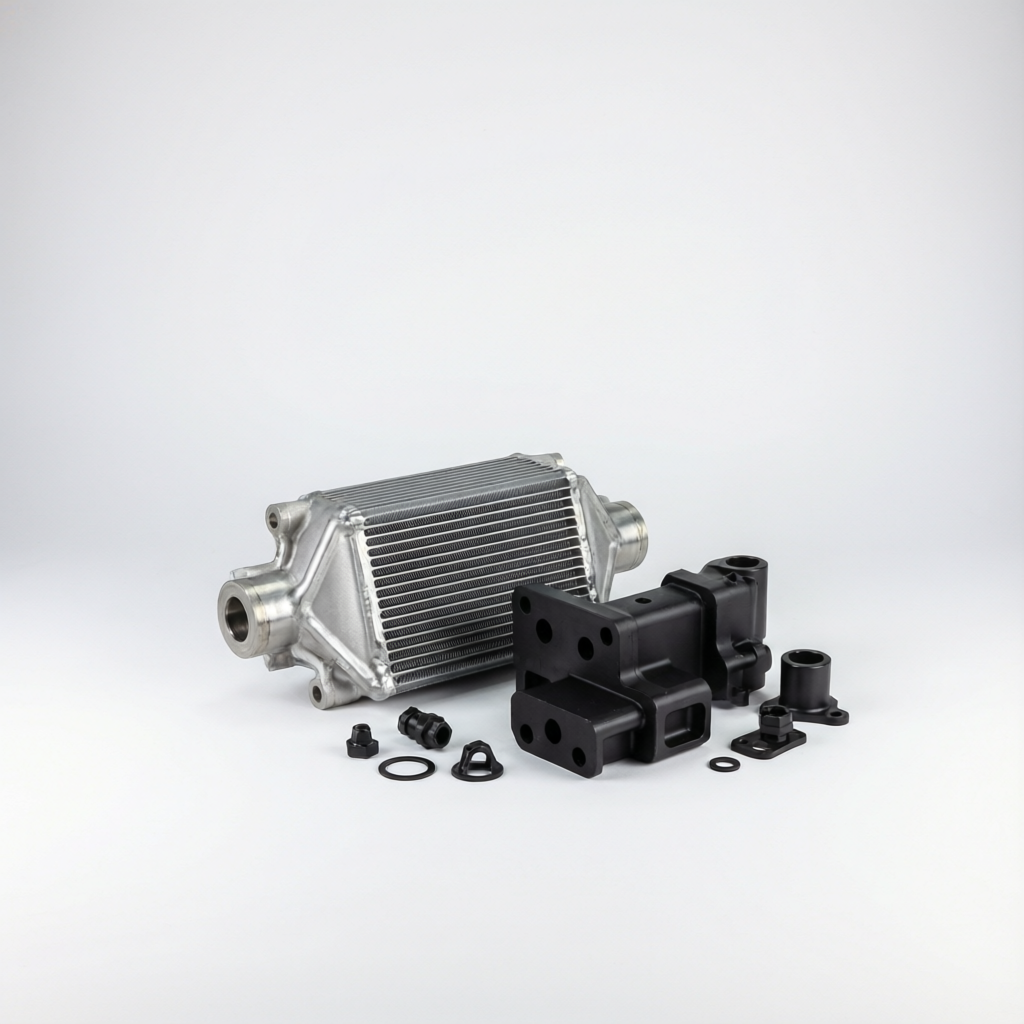

If you own a 2017–2023 L5P Duramax and you’ve spent any time on diesel forums, you’ve absorbed the conventional wisdom: EGR systems are ticking time bombs, the cooler will crack and hydrolock your engine, and the only responsible move is to delete everything yesterday.
Here’s what the forums don’t tell you: the L5P’s EGR system is fundamentally different from the LML and LMM generations that earned that reputation. GM redesigned the hardware, tightened the integration, and built a system that genuinely fails less often than its predecessors. And the L5P has a different problem — one that builds quietly over tens of thousands of miles, doesn’t throw a code until it’s severe, and affects every single truck regardless of maintenance habits.
What the L5P EGR System Actually Does to Your Engine
Before talking about repair or delete, you need to understand what’s happening inside the system — because the popular explanation (“EGR burns off harmful NOx by recirculating it through the engine”) is scientifically backwards.
The Chemistry No One Explains
NOx forms anytime you have three things in the same place: heat above roughly 2,200°F, oxygen, and nitrogen. Your combustion chamber has all three in abundance. The air entering your engine is 78% nitrogen and 21% oxygen — and diesel combustion temperatures routinely exceed 2,500°F at the flame front.
EGR does not “burn off” NOx. Heat creates NOx; adding more heat cannot destroy it. What EGR actually does is prevent NOx from forming in the first place, through two mechanisms:

1. Oxygen Displacement.
Exhaust gas is inert — its oxygen was already consumed by combustion. When the EGR valve opens and routes a portion of exhaust back into the intake, it displaces fresh air. The intake charge now contains less oxygen per unit volume. Less available oxygen means fewer nitrogen-oxygen bonds can form during combustion.
The Oxygen Dilution
A diesel runs lean by design — the stoichiometric ratio is 14.5:1, but diesels won’t even combust cleanly below about 20:1, and under light load the air-fuel ratio can reach 70:1 or higher. There’s almost always surplus oxygen. Displacing some of it reduces NOx without starving the combustion event.
2. Higher Heat Capacity And Slower Combustion.
Exhaust gas — primarily CO₂ and water vapor — has a higher specific heat capacity than the nitrogen and oxygen in fresh air. When you mix exhaust gas into the intake charge, the resulting mixture absorbs more heat per degree of temperature rise. The same combustion energy produces a lower peak temperature.
Reduce NOx
With less oxygen available, diesel fuel molecules take longer to find oxygen partners — the combustion event spreads out over more crank angle degrees instead of releasing all its heat in a sharp spike. Lower peak temperature + slower heat release = dramatically less NOx. SAE research shows EGR reduces NOx by approximately 75–80% at full load.
The 8 Documented Effects (Only One Is Good)
The Journal Energies reviewed the effects of EGR on diesel engines across multiple peer-reviewed studies. Here’s the tally:
| Effect | Direction | What It Means for You |
|---|---|---|
| NOx emissions | ↓ Reduced | The single intended benefit — 75–80% reduction at load |
| Soot / particulate matter | ↑ Increased | More carbon in oil, more DPF loading |
| Carbon monoxide (CO) | ↑ Increased | Incomplete combustion byproduct increases |
| Hydrocarbons (HC) | ↑ Increased | Unburned fuel in exhaust increases |
| Power output | ↓ Reduced | Peak torque drops as EGR rate increases |
| Fuel consumption | ↑ Increased | Brake-specific fuel consumption rises with EGR rate |
| Maintenance burden | ↑ Increased | Faster oil contamination, intake fouling |
| Engine wear | ↑ Increased | Component wear increases — with important caveats |
What the Wear Data Actually Shows
The most cited study on EGR wear is SAE technical paper 1999-01-0839, titled “The Effects of EGR on Diesel Engine Wear.” It’s rigorous work, but it has limitations that forum discussions routinely ignore:
-
Test engine: A 1990s-era diesel with a Bosch VE mechanical injection pump, single-shot 5-hole injectors, and a fixed-geometry turbo — an engine that inherently produced far more soot than any modern common-rail L5P.
-
Test conditions: Medium to full load at 25% EGR rate — representative of a tractor or marine engine at continuous high output, not a pickup that spends most of its life at 20–30% throttle cruising.
-
“Aged oil” definition: The study’s aged oil had viscosity breakdown, soot percentage, oxidation, and wear metals that were drastically elevated — equivalent to running oil 5x past the recommended change interval. Not the difference between a 5,000-mile and 10,000-mile oil change.
The study’s most interesting finding: piston ring wear is a trade-off, not a one-sided story. The top compression ring actually wore more without EGR because it sees higher combustion temperatures. The second ring, third ring, and oil control ring wore more with EGR because soot-contaminated oil is more abrasive at those positions.
Here’s The Real-world Reality Check:
there are hundreds of documented million-mile Duramax, Cummins, and Power Stroke engines still running factory EGR systems. If EGR were truly destroying engines, the commercial trucking industry — which lives and dies by maintenance costs per mile — would have collapsed decades ago.
The Practical Takeaway:
EGR increases engine wear on paper, but at rates that are unlikely to matter over the ownership lifetime of a properly maintained L5P. If you change oil at appropriate intervals and don’t subject the engine to sustained full-load operation on degraded oil, EGR-related wear is not your engine’s limiting factor.
That said, “properly maintained” includes dealing with the carbon buildup that EGR unavoidably causes — and on the L5P, that buildup is real.
The L5P Reliability Picture: Better Than Older Duramax, But Not Problem-Free
When GM moved from the LML (2011–2016) to the L5P (2017+), the entire emissions architecture got a serious redesign. The EGR cooler and valve hardware were updated for improved durability, and GM tuned the system to lean less heavily on aggressive recirculation than the LML did.
But the fundamental physics haven’t changed. The EGR system still routes hot, soot-laden exhaust gas back into a clean intake. Over tens of thousands of miles, that recirculated exhaust deposits hard carbon in the intake manifold, on the EGR valve, and through the intake runners.
Here’s what the failure timeline looks like — not from forum anecdotes, but from the combination of mechanic teardowns and known L5P degradation patterns:
| Mileage | What You’ll Notice | What’s Happening Internally |
|---|---|---|
| 0–30,000 | Possibly nothing obvious. Slight throttle dullness. | Carbon film forming on intake runners and Y-bridge. EGR valve seat beginning to accumulate deposits. MAP sensor still reading accurately. |
| 30,000–80,000 | Subtle fuel economy dip (0.5–1.5 MPG). Throttle response no longer feels “new truck” crisp. | Intake manifold carbon crust is measurable. EGR valve movement range begins to narrow. MAP sensor contamination starts biasing readings — ECM compensates but efficiency suffers. |
| 80,000–150,000 | Check engine light may appear: P0401 (insufficient EGR flow), P0402 (excessive flow), or P0403–P0406 (circuit/performance). Coolant level may begin to drop with no visible leak. | EGR valve stroke is restricted by carbon. Cooler internal passages developing micro-cracks from thermal cycling. Intake port cross-section is measurably reduced — airflow restriction increases pumping losses. |
| 150,000+ | White smoke from tailpipe (sweet smell = burning coolant). Overheating under load. Potential limp mode. Worst case: hydrolock from coolant ingestion. | EGR cooler has cracked internally. Coolant enters intake stream. If severe, cylinder compression + liquid coolant = bent connecting rod. |
What 22,000 Miles Actually Looks Like
In a 2024 teardown by Truck Stuff, a 22,000-mile L5P was disassembled for EGR and DPF cleaning. The findings were sobering. Despite the owner being careful about fuel quality and not abusing the truck:
- The Y-bridge interior was coated in black, crusty carbon deposits — visibility into the ports was near zero.
- Both MAP sensors were completely caked with soot — enough to bias readings and silently degrade fuel economy and performance.
- The EGR valve and cooler assembly had substantial carbon layering, despite the truck never throwing a code.
- The entire EGR assembly — valve, cooler, heat shields, piping, and trapped coolant — weighed over 23 pounds.
Twenty-two thousand miles. That’s less than two years of average driving. The carbon buildup isn’t waiting for 100,000 miles — it starts on day one. The only question is when it crosses the threshold from “present but manageable” to “causing measurable problems.”
The Real Cost Equation: Repair vs EGR Delete vs Full Delete
On an LML or LMM, an EGR-only delete is a perfectly reasonable standalone fix — the cooler is the #1 failure point, removing it solves the problem, and tuning costs are modest. On the L5P, the locked ECM introduces a cost variable that reshapes the entire equation.
Here’s the honest breakdown:
| Cost Category | Dealer EGR Cooler Replacement | EGR-Only Delete (Hardware + Tune) | Full Delete (EGR + DPF/DEF + Tune) |
|---|---|---|---|
| EGR cooler/valve parts | $800–$1,500 (OEM) | N/A (removed) | N/A (removed) |
| Labor | $750–$1,500 (4–7 hrs @ dealer rate) | 2–4 hrs DIY or $400–$800 shop | 6–10 hrs DIY or $1,000–$2,000 shop |
| Delete hardware | N/A | $130–$600 (EGR block-off kit) | $800–$2,000 (full pipe kit + EGR kit) |
| ECU tune | N/A | $800–$1,400 (L5P ECM unlock + calibration) | $800–$1,400 (one tune covers everything) |
| Downpipe | N/A | Optional: $300–$600 | Strongly recommended: included or $300–$600 |
| Total upfront | $1,550–$3,000 | $1,330–$2,600 | $2,600–$5,000 |
| 5-year outlook | Another cooler may fail. Carbon fouling continues. Regen/DEF costs accrue. | No EGR failures. DPF/DEF problems remain. Future DPF repair: +$2,000–$4,000. | No emissions failures. No DEF cost. Fuel economy improvement of 1–3 MPG typically. |
| True 5-year cost | $3,000–$6,000 (includes next failure + DEF) | $3,500–$6,500 (EGR delete now + DPF repair later) | $2,600–$5,000 (one and done) |
Reading This Table Honestly
The dealer repair path appears cheapest upfront at $1,550–$3,000. But that replaces your failed EGR cooler with an identical OEM unit — same design, same thermal stress, same eventual failure mode. You’re paying to reset the clock, not stop it.
The full delete is the highest one-time cost — but it’s also the only option where you pay for the tune once and eliminate every emissions failure point in a single job. For a truck you plan to keep beyond 3 years, it is typically the cheapest path per year of ownership.
Counterpoint: The Case for Keeping Emissions Intact
Calibrated Power, a well-known diesel tuning shop, published a data-driven argument against deletion that deserves airtime. Their key points:
-
DPF does not meaningfully restrict horsepower on the L5P. They dyno-tested a 2021 emissions-intact L5P with a Stealth STR turbo and custom tuning: 628 rear-wheel horsepower. The DPF was not the bottleneck.
-
The ROI math for full deletion is longer than most owners realize. Calibrated Power calculated a full L5P delete at $6,000–$7,000. Average yearly maintenance for an emissions-intact 2017 L5P is reported around $1,000. That’s a 6–7 year payback period before the delete “pays for itself.”
-
Tuning support is a moving target. U.S.-based delete tuners are being fined and shut down at an accelerating rate. If your tuner disappears, you’re left without support for future updates or troubleshooting.
-
Resale value takes a real hit. Dealers won’t touch a deleted truck. Private buyers who understand the legal risks are reluctant.
-
Federal law is not a suggestion. Tampering with emissions equipment violates the Clean Air Act. Fines start at $5,000 per violation for individuals. Shops face six-figure penalties. In the most extreme cases, non-compliant vehicles have been crushed.
How to Choose
These are not trivial arguments. For an owner who drives 8,000 miles a year, plans to sell within 3–4 years, and lives in a state with emissions testing, keeping the system intact and maintaining it proactively may be the smarter financial move.
For an owner who keeps trucks 200,000+ miles, tows heavy, lives where enforcement is minimal, and wants to set and forget the emissions system permanently, the full delete math still wins — but it’s not the slam dunk that forum culture presents.
The L5P ECM Lock: The Cost Multiplier No One Talks About
GM deployed a significantly more locked-down ECM on the L5P that was — especially on early production years — notoriously difficult to crack. This single fact changes the economics of every delete decision on this platform:
-
Tuning is the most expensive single line item in any L5P delete. At $800–$1,400 for an ECM unlock plus custom calibration, the tuning cost alone can exceed the cost of all the physical delete hardware combined.
-
You only want to pay this cost once. An EGR-only delete is one tune. A DPF delete later is a second tune — or at minimum a recalibration fee. A full delete from the start is one tune.
-
Not all model years have equal tuning support. Early L5Ps (2017–2019) have the broadest support. 2020+ trucks use an updated ECM that’s harder to access. 2023–2024 trucks have extremely limited tuning availability — at time of writing, only a handful of tuners support them.
This is why the aftermarket has largely consolidated around full L5P delete solutions rather than EGR-only kits. The industry recognized that once an owner is paying the ECM tax, it makes more sense to address everything at once. The market for standalone EGR delete kits on the L5P exists, but it’s smaller than on older platforms.
EGR-Only vs Full Delete: The Decision Framework
Given everything above — the L5P’s improved EGR reliability, the carbon fouling timeline, the ECM lock cost, and the counterarguments — here’s a decision framework that accounts for how you actually use your truck:
| Your Situation | Recommended Path | Why |
|---|---|---|
| EGR cooler has already failed | Full delete | You’re already paying the ECM tune tax. Delete everything in one job and eliminate DPF/DEF as future failure points. |
| No current failure, keeping truck 5+ years, towing heavy | Full delete | Long-term reliability and reduced EGTs during sustained towing justify the upfront cost. One tune, permanent solution. |
| No current failure, keeping truck 2–4 years, moderate use | Maintain + induction clean | The ROI timeline on a full delete ($6K) vs maintenance ($1K/yr) doesn’t close in your ownership window. |
| No current failure, live in strict emissions state, sell within 3 years | Maintain stock | Legal risk + resale penalty outweigh reliability benefit. Use synthetic oil, maintain on schedule, induction clean every 30K. |
| No current failure, vehicle is competition/off-road only | Full delete | No legal constraint. Maximum reliability and performance. Delete everything. |
| Budget-constrained, EGR problems starting, can’t afford full delete | EGR delete only | If the choice is between EGR delete now vs doing nothing until failure, delete now is the lesser evil. Plan for full delete later. |
Power Level Guide
If you’re planning to tune for more power regardless of emissions concerns, the required approach changes:
| Power Target | Required EGR Strategy | Why |
|---|---|---|
| Stock to +50 HP | EGR delete strongly recommended | Prevents future cooler failure. Improves reliability without pushing boundaries. |
| +50 to +100 HP | EGR delete required | Higher cylinder pressures and EGTs demand clean intake air. EGR flow at this level hurts more than it helps. |
| +100 to +200 HP | Full delete (EGR + DPF) required | Exhaust flow becomes a real bottleneck. The DPF will become a restriction at sustained high output. |
| +200 HP and above | Full delete + supporting mods mandatory | At this power level, the factory emissions hardware is incompatible with safe operation. Upgraded turbo, fuel system, and complete exhaust required. |
A note that matters:
The power comes from the tune — adjusting injection timing, fuel quantity, and boost targets to take advantage of cooler, cleaner intake air. An EGR delete without a tune produces no power gain and may actually run worse due to altered airflow characteristics the stock ECM isn’t calibrated for.
Product Spotlight: IFJF L5P EGR Delete Kit
If the full delete path aligns with your situation, the hardware matters. The L5P’s EGR system operates at high exhaust temperature and pressure — a budget kit with thin stamped steel plates and subpar gaskets is not a place to save $50.
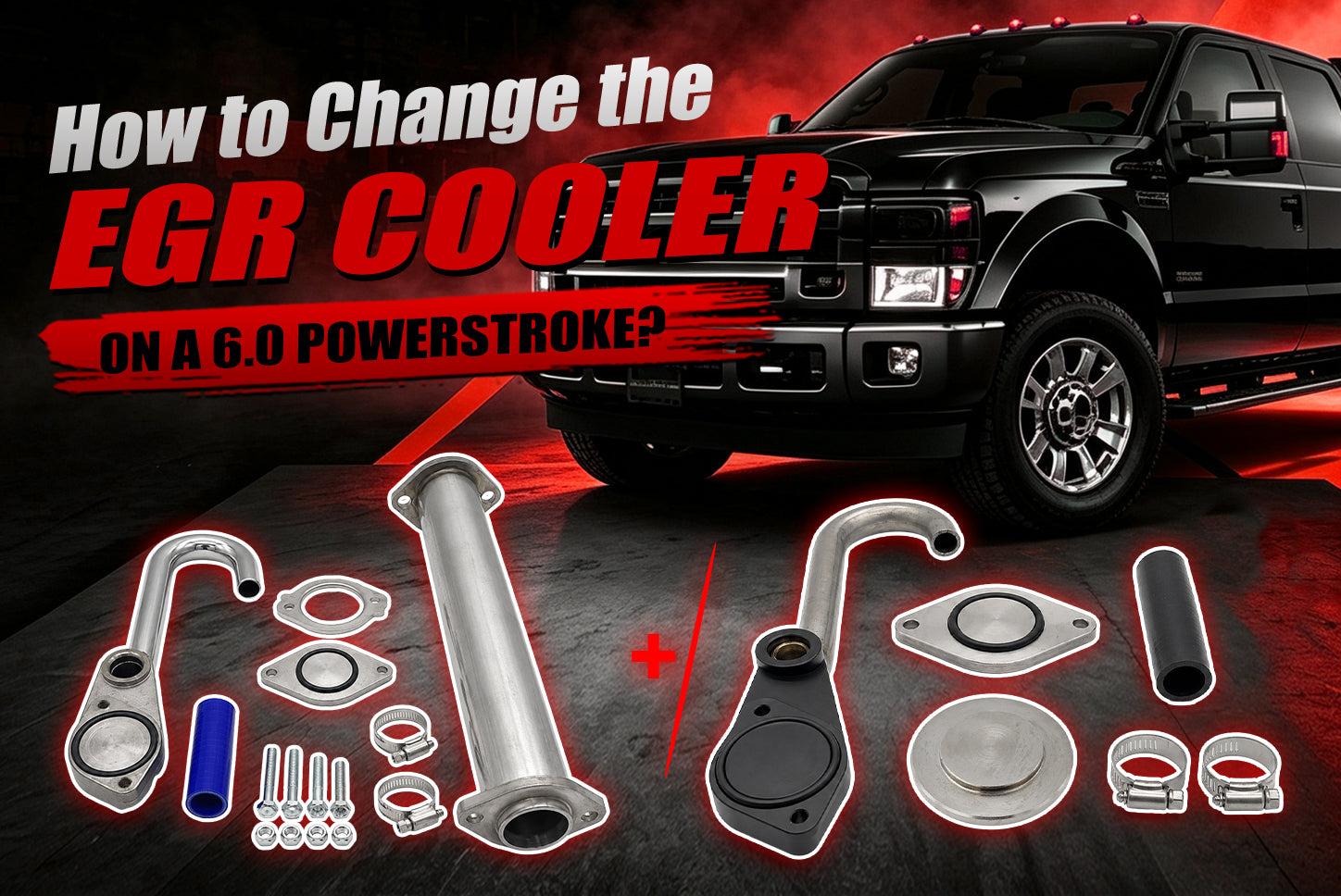
EGR Delete Kit | GM/Chevy Duramax 2017-2023 L5P 6.6L
The IFJF 2017–2023 L5P EGR Delete Kit addresses the key failure points on the L5P platform:

-
Material quality that matters: Billet aluminum block-off plates, stainless steel hardware, and high-temperature silicone hoses. Aluminum doesn’t warp under exhaust-gas temperature cycling the way thin steel plates do — a warped plate means an exhaust leak.
-
Coolant loop properly re-routed: Removing it opens the factory cooling circuit. This kit includes the necessary coolant bypass fittings and lines to keep the system sealed — no improvised hose plugs that risk air pockets or coolant weeping.
-
Complete hardware: Block-off plates, gaskets, bolts, coolant bypass lines, and installation hardware in one package. No mid-install run to the parts store.
-
Fits 2017–2023 6.6L L5P: Silverado and Sierra 2500HD/3500HD. Does not fit Cab & Chassis models.
The install is not trivial — expect 2–4 hours for a competent DIY mechanic. The Y-bridge must be removed for access, which requires disconnecting the AC compressor, throttle body, intercooler piping, and multiple wire harnesses. Budget a full weekend if this is your first L5P deep-dive.
Why the Downpipe Deserves Equal Priority
One of the most common mistakes with an L5P EGR delete is treating it as a standalone job and leaving the factory downpipe in place. The logic sounds reasonable — “I’ll delete the EGR now, deal with the exhaust later” — but it misses how these systems interact.
The factory L5P downpipe necks down aggressively to feed the DOC (Diesel Oxidation Catalyst), which is the first element in the exhaust aftertreatment chain. Even with the EGR deleted and the intake breathing clean air, the stock downpipe remains a significant restriction.
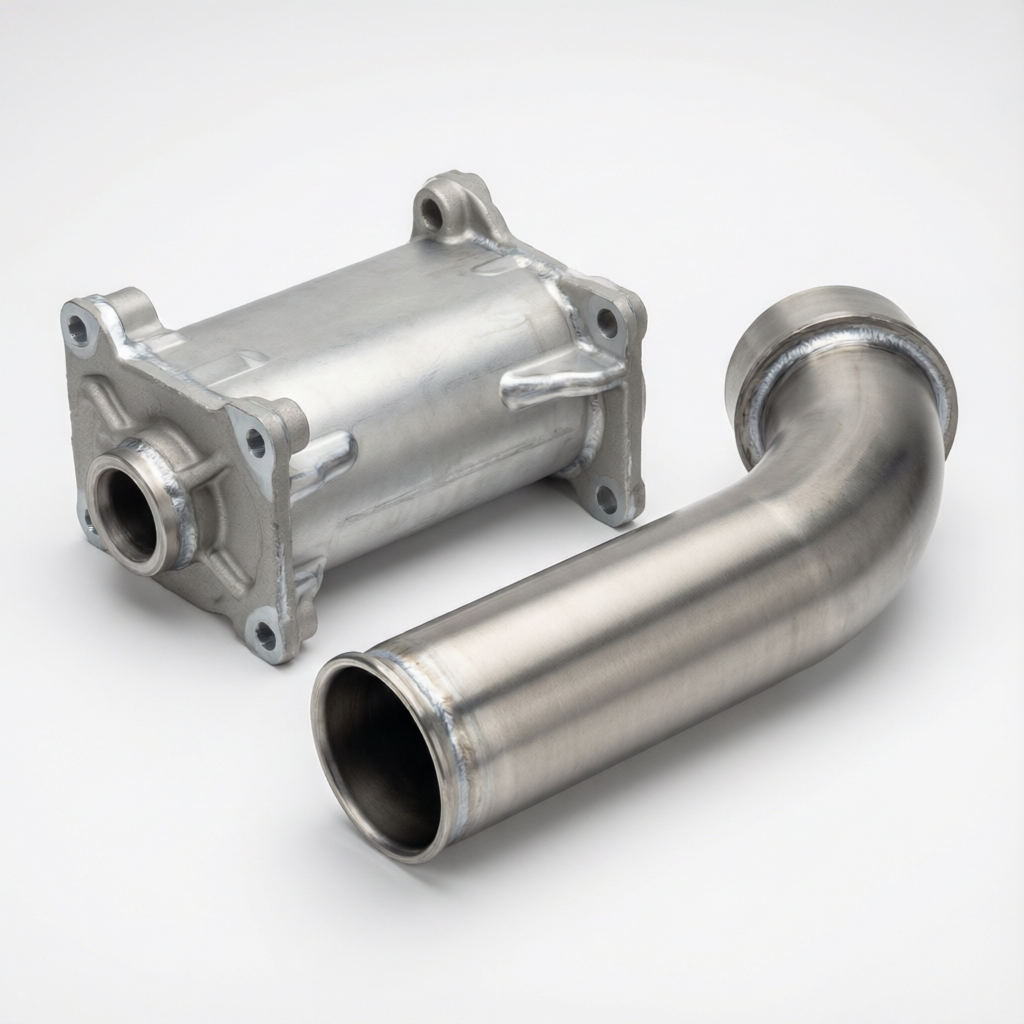
3.5" Downpipe | EGR Delete | 2017-2023 GM/Chevy Duramax L5P 6.6L
The IFJF 3.5" L5P Downpipe replaces the factory downpipe with a 3.5-inch mandrel-bent stainless steel pipe designed specifically for emissions-deleted L5Ps:

- 20% better flow than factory pipe — the diameter increase and mandrel bend geometry reduce backpressure that the turbo has to fight against
- Eliminates the DOC entirely — the factory downpipe’s DOC section is the first exhaust restriction after the turbo; removing it drops EGTs and improves turbo response
- Direct fitment — no cutting, welding, or fabrication required; designed for the L5P chassis
- Stainless steel construction — handles the thermal cycling of a turbocharged diesel without corrosion or fatigue cracking
- Combined EGR + downpipe package available — eliminates EGR hardware and the DOC bottleneck in one coordinated install
The practical benefit of doing the downpipe and EGR delete together is that they share labor. Both require removing the Y-bridge and accessing the turbocharger area. Doing them as separate jobs means removing and reinstalling the same components twice.
Installation Realities: What Goes Wrong and How to Avoid It
The EGR delete install itself is well-documented — there are multiple video walkthroughs covering bolt locations, torque specs, and coolant drain procedures. What’s less discussed is what goes wrong after the install. And the #1 post-delete issue across Duramax platforms is the same: the Y-bridge up-pipe joint loosens and creates a boost leak.
Here’s The Problem:
Underneath the Y-bridge, where it mates to the up-pipe from the exhaust manifold, there’s a large O-ring seal. If the up-pipe bolts aren’t torqued properly — or if the assembly is forced into position with bolt tension rather than being seated by hand first — that O-ring doesn’t seal completely.
The Fix:
When mating the Y-bridge to the up-pipe, push the assembly together by hand until it seats fully before tightening any bolts. The bolts are there to hold the seal, not to pull the parts into alignment. After torquing everything to spec, grab the up-pipe and try to wiggle it — if there’s any movement, the O-ring isn’t sealed, and you’ll be pulling it apart again.
Other Common Install Pitfalls:
-
Coolant system air pockets: The EGR cooler holds a meaningful volume of coolant. After installing the bypass lines, the system must be properly burped. Run the engine with the coolant cap off, heater on full, until the thermostat opens and coolant level stabilizes.
-
AC compressor reinstallation: The compressor must be unbolted (not disconnected from refrigerant lines) to access the Y-bridge bolts. When reinstalling, the compressor belt tension must be correct — too loose and you’ll get chirping; too tight and you’ll eat the compressor bearing.
-
MAP sensor cleaning: If you’re not replacing the MAP sensors, clean them thoroughly with MAP sensor cleaner before reinstalling. A contaminated MAP sensor will feed incorrect data to the ECM, and on a tuned truck.
The Other Side: When Keeping EGR Makes More Sense
To be clear about the counterarguments — because a responsible guide presents both sides — there are scenarios where deleting the L5P EGR system is genuinely not the right call:
You live In Any State With Visual Emissions Inspection.
The truck won’t pass. Even states that only do OBD-II plug-in checks are increasingly adding visual inspections for diesel emissions equipment. The risk-reward calculation changes dramatically when a failed inspection means your truck can’t be registered.
You Plan to Sell or Trade Within 3 Years.
A deleted truck is harder to sell, fetches a lower price, and cannot be traded in at a dealership. The financial penalty of deletion at resale can easily exceed whatever you saved in maintenance costs over that ownership period.
Your Annual Mileage is Low (<10,000 Miles/Year).
At $1,000/year average maintenance, a full delete costing $3,000–$5,000 takes 3–5 years to break even at low mileage — and that’s before accounting for tuning risk and resale impact.
You Don’t Have A Confirmed Tuning Solution.
Buying delete hardware without verifying that a tuner supports your specific model year and ECM version is gambling. A delete pipe you can’t tune for is scrap metal.
You’re Comfortable With Induction Cleaning As Maintenance.
If regular induction cleaning (every 30,000–50,000 miles) is acceptable to you, and you’re okay accepting the residual risk of a cooler failure at high mileage, the stock system can deliver a long service life.
Conclusion
The L5P Duramax exists at an inflection point in diesel emissions history. The EGR system is more durable than its predecessors, the DPF and SCR are more sophisticated, and the locked ECM has made tuning more expensive and less accessible than it was a decade ago. The simple “just delete it” advice that applied to LMLs and LMMs doesn’t translate cleanly to this generation.
Whatever path you choose, make it an informed one. The forums are full of confident advice from people who’ve never turned a wrench on an L5P. The data says this generation is different — better in some ways, more complicated in others — and your decision should reflect that reality, not the diesel folklore of 2012.
Disclaimer: This article is for informational purposes only. Emissions system modifications may violate federal, state, and local laws. Always verify legal compliance in your jurisdiction before purchasing or installing emissions-related components.
FAQ
Q1: Does the L5P really need an EGR delete, or is that just forum hype?
A: Less urgently than older Duramax trucks. The L5P EGR system is more reliable — catastrophic early-mileage cooler failures are rare. But carbon fouling is real and universal. Whether deleting is worth it depends on your ownership timeline and willingness to do induction cleaning as maintenance.
Q2: Can I just unplug the EGR valve instead of deleting it?
A: No — this is the worst compromise. Without a tune, you’ll trigger a check engine light and likely limp mode. Even with a tune, exhaust backpressure can force the valve open under high boost, and the EGR cooler remains in place as a failure point. If you’re tuning anyway, install the block-off plates and remove the hardware permanently.
Q3: Will an EGR delete improve my L5P’s fuel economy?
A: Only with a proper tune — the delete itself doesn’t change MPG. A quality tune typically delivers 1–3 MPG improvement by optimizing injection timing and boost for cooler intake air. An improperly tuned truck can actually burn more fuel than stock. The tune quality determines the result
Q4: Why is a full delete usually recommended over an EGR-only delete on the L5P?
A: Three reasons. First, tuning the locked ECM is the most expensive step — paying for it twice (EGR now, DPF later) is poor economics. Second, the DPF/DEF/SCR system causes most L5P owner frustration (regen cycles, clogged filters, derate codes). Third, the aftermarket has consolidated around full solutions because one tune + one install is cleaner than piecemeal work.
Q5: Does the CP4 fuel pump issue factor into this decision?
A: Indirectly, yes. The L5P uses the CP4.2 pump — while failure rates are lower than the 2011–2016 LML, a CP4 failure can still destroy the entire fuel system (injectors, rails, lines, tank) for $10,000+.
Q6: Is deleting my L5P’s EGR system legal?
A: For off-road and competition use only. Under the Clean Air Act, tampering with emissions equipment on street-driven vehicles is a federal violation — fines start at $5,000 per violation for individuals and much higher for shops. States with diesel emissions testing enforce this at inspection. Always check your local regulations before purchasing.