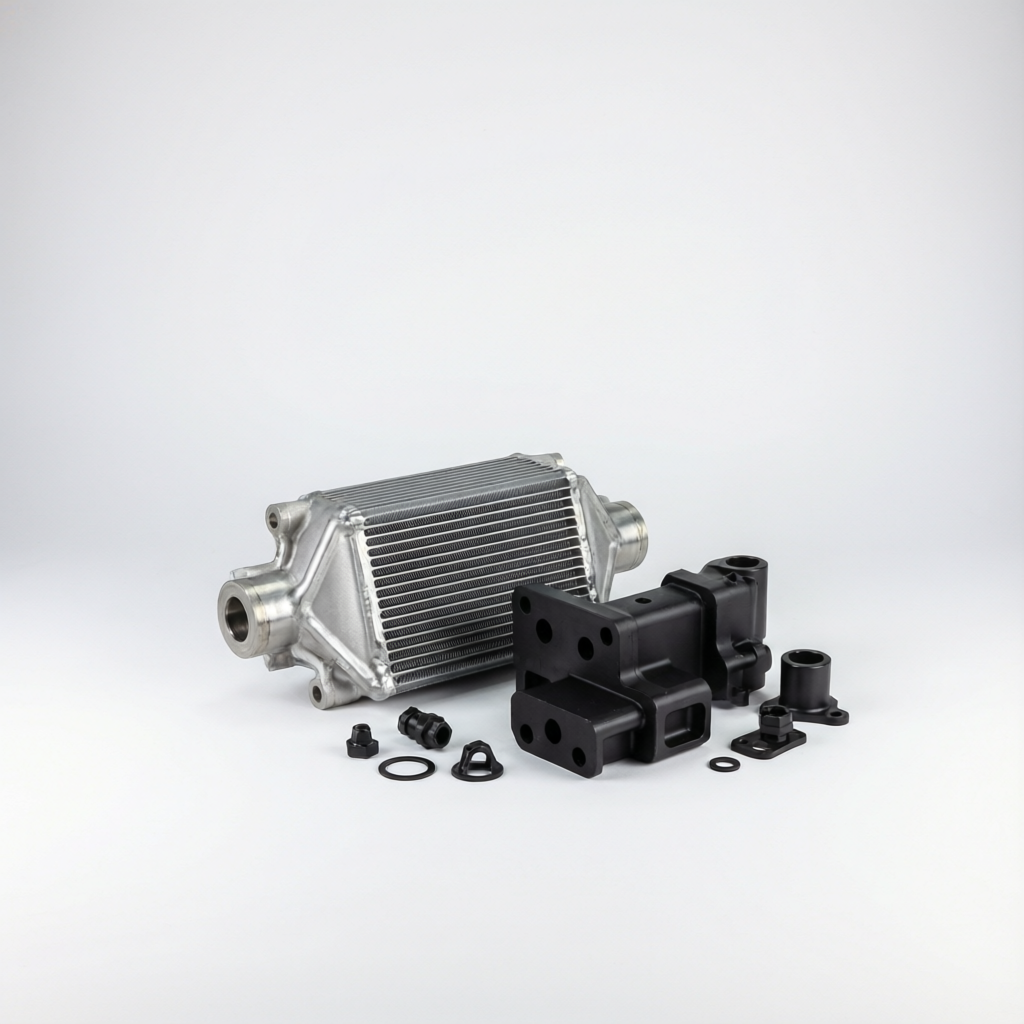

Turbocharged engines, while delivering astonishing power, also face a key challenge: high temperatures. When air is compressed by the turbine, its temperature rises sharply, which not only reduces the intake density and weakens combustion efficiency, but also imposes a continuous thermal load on the engine. And the intercooler is precisely the component that solves this problem. So, how exactly does the intercooler work?
Whether it's the diesel heavy trucks that strive for the ultimate performance, the performance-oriented modified vehicles, or every car owner who cares about the health of their vehicle, understanding the working principle of the intercooler is a necessary course for optimizing engine performance and extending the lifespan of core components. Next, we will provide you with a systematic analysis of this key technology and help you make a wise decision for upgrading your cooling system.
Why Is the Intercooler A Core Component ?
It is essentially a heat exchanger, specifically designed to cool the high-temperature air that has been compressed by the turbocharger or the mechanical supercharger. The turbine is responsible for increasing the intake volume to enhance power, while the intercooler optimizes the intake air for optimal combustion by cooling it.
Why Must Compressed Air be Cooled?
- Pressure increase accompanied by temperature rise: When air is compressed, its temperature will rise sharply
- High temperature reduces density: The oxygen content in the hot air per unit volume significantly decreases
- Oxygen deficiency reduces power: High-temperature intake directly leads to a decrease in combustion efficiency
- Excessive heat poses risks: Excessive intake air temperature may cause detonation and mechanical damage
By understanding these four key points, you will be able to comprehend the dual roles that the intercooler plays in terms of power output and engine protection.
The Working Principle of the Intercooler
The core of the intercooler in addressing the issue of high temperatures lies in its ingenious heat exchange mechanism. The entire working process follows straightforward and efficient physical principles:
Heat Exchange Process
- High-temperature compressed air flows into the internal pipes of the intercooler
- The external environment air (or coolant) flows through the exterior of the intercooler
- Heat is transferred from hot air to the cold medium through the metal fins
- After cooling, the denser and cleaner air enters the engine combustion chamber
Two Mainstream Intercooler Methods
Air-to-Air Intercoolers
- The most widely used type in the automotive field
- Utilizing the airflow generated by vehicle movement for cooling
- Usually installed at the front position of the radiator.
- Simple in structure, highly efficient and with outstanding cost-effectiveness.
Air-to-Water Intercoolers
- Heat dissipation is achieved through the circulation of coolant.
- The structural design is usually more compact.
- Can provide a more stable cooling effect
- Commonly seen in high-performance and space-constrained modification schemes
Comparison of Actual Intercooler Effects
- Standard air-to-air system: Capable of achieving a temperature reduction range of 50 - 100°F
- Efficient modification system: Can achieve a significant improvement of 100-150°F
- Air-to-water system: Typically maintains a stable range of 60-120°F
The Core Value of the Intercooler
For a turbocharged engine, the intercooler is not an auxiliary component but a core component that ensures performance and reliability. Its true value lies in three key dimensions:
1. Significant Enhancement of Power Performance
Cold air means higher density and more abundant oxygen. Empirical data shows that an effective intercooler system typically can result in a 10-20% increase in on-race horsepower, and the improvement is more significant in high-temperature conditions. This not only enhances the instantaneous burst of power but also ensures the continuous stability of power output.
2. System Optimization of Combustion Efficiency
Through precise temperature control, the intercooler ensures that each combustion process is more efficient:
- Significantly improve the quality of fuel-air mixture
- Significantly reduce the probability of detonation occurrence
- It can still maintain ideal fuel economy under high-load conditions.
- Complete combustion reduces emissions
3. Long-term Guarantee for Core Components
The cooling radiator also plays a crucial role in protecting the engine:
- Temperature control: Effectively distribute heat load, reduce exhaust temperature, and prevent critical components from being damaged due to overheating.
- Anti-chip protection: Cooling the intake air fundamentally prevents abnormal combustion, creating physical conditions for increasing the boost value for safety.
- Extended lifespan: By maintaining an appropriate operating temperature, the service life of core components such as pistons and cylinder heads can be significantly prolonged.
Radiator vs. Intercooler: Analysis of Functional Differences
Although both belong to heat exchangers, radiators and intercoolers play completely different roles in the automotive cooling system. To put it simply: The radiator protects the engine itself, while the intercooler optimizes the intake air efficiency.
Clear Division of Responsibilities Based on Functional Positioning
Cooling Radiator
Specifically designed to cool the coolant in the engine circulation system. By dissipating heat into the air, it maintains the engine within the optimal operating temperature range. It is an indispensable core component for all water-cooled engines.
Intercooler
Specifically cools the high-temperature intake air that has been compressed by the turbocharger. By increasing the intake air density, it enhances combustion efficiency. This is a unique performance optimization device for turbocharged and supercharged engines.
The Key Differences in Structure and Layout
Installation Location
- Radiator: placed directly in front of the engine, facing the wind, and works in conjunction with the cooling fan
- Intercooler: usually installed between the turbocharger and the intake manifold. In some models, it is arranged side by side with the radiator
Internal Structure
- Radiator: more intricate piping is used to ensure effective heat exchange between the coolant and the air
- Intercooler: adopts a larger airflow channel design to accommodate the characteristics of air flow, and its fin structure has also been optimized for gas heat transfer
When and How to Optimize Your Intercooler System
After you understand the crucial role of the intercooler in heat management and power output, upgrading it specifically becomes a key step in unlocking the engine's potential. This is not merely about replacing the component, but rather a systematic strengthening of the entire vehicle's heat dissipation architecture.
The Core Advantages of High-performance Intercoolers
- By using a larger-sized heat dissipation core, the heat dissipation capacity is significantly enhanced
- Optimize the internal heat sink to achieve more efficient airflow organization and heat exchange
- Reduce the pressure loss when air flows through the radiator
- Improve the design of the heat dissipation cover to ensure smooth air flow
Key Scenarios that Require Considering An Upgrade
- Planning or implementation of a significant increase in pressure values
- Other performance modifications such as intake and exhaust or program modifications have been carried out
- Vehicles often operate in hot or continuously high-load conditions
- A clear "thermal saturation" phenomenon occurred
Proposed Systematic Renovation Plan
The efficiency of the intercooler upgrade often requires a coordinated renovation to be fully realized:
- Replace the intake pipe with a larger diameter and a smoother inner wall to reduce air resistance
- Combined with a high-performance intake system, it ensures an adequate supply of cold air
- Upgrade the associated heat dissipation components when necessary.
By optimizing the ECU specifically, the upgraded thermal management potential can be - fully exploited
Maintenance Points and Fault Troubleshooting Guide
To ensure that the intercooler system operates continuously and efficiently, proper maintenance and timely fault diagnosis are of vital importance. The degradation of the system's performance usually begins with imperceptible daily wear and tear.
Key Items for Daily Maintenance
-
External cleaning: Regularly clean the heat dissipation fins to ensure smooth airflow
-
Structural inspection: Carefully examine whether there are any physical damages to the shell caused by foreign object impacts
-
Sealing inspection: Check whether there are any oil stains at all pipe connections and the main body of the intercooler
- Data monitoring: Focus on intake air temperature data
Common Questions and Handling Strategies
-
Thermal attenuation phenomenon: Consider upgrading to a larger or more efficient intercooler.
-
Leakage issue: If a leak is detected, it should be immediately repaired or the relevant components replaced.
-
Internal blockage: Professional cleaning or replacement is required.
- Performance bottleneck: Select the model that matches the power upgrade.
Fault Identification and Diagnosis Steps
Fault Identification
- The power output has significantly decreased
- The intake air temperature has abnormally risen
- Visible physical damage or traces of oil leakage
- The exhaust temperature remains consistently high
Diagnosis Steps
- Conduct a visual inspection of the intercooler and its piping
- Carry out a pressure test to confirm the system's sealing performance
- Measure and compare the temperature difference between the inlet and outlet of the intercooler
- Compare the measured data with the original factory technical specifications

Conclusion:
In the world of turbocharging, the intercooler is the key to achieving performance and reliability. Its core function is straightforward: it cools the hot air compressed by the turbocharger into high-density air, which not only enhances the engine power but also avoids damage caused by high temperatures. It is not merely a cooling component; it is also an essential partner for ensuring the efficient and safe operation of the turbo system.
To fully unleash the performance of your vehicle? The key lies in the overall coordination of the system. dieseltok.com offers professional solutions for diesel vehicle exhaust and emission systems. Our DPF system, EGR scheme and exhaust components can seamlessly integrate with your cooling system upgrade. Welcome to learn how to achieve comprehensive and lasting performance improvement through systematic optimization.
FAQs About Intercoolers
Q1: Can the intercooler save fuel?
A1: Yes. The intercooler cools the intake air to enhance combustion efficiency and reduce the engine's heat load. Especially under load conditions, it optimizes the air-fuel ratio, typically resulting in a 1-3% improvement in fuel economy.
Q2: How often does the intercooler need maintenance?
A2: It is recommended to clean the external heat sink at least once a year and check for any blockages or damages. During regular maintenance, it is also necessary to inspect whether there are any leaks in the piping and interfaces to ensure that the entire intake cooling system is properly sealed.
Q3: Does the intercooler need a fan to work effectively?
A3: The intercooler does not necessarily require a fan to function. Its core principle is to dissipate heat through air flow. The fan mainly enhances the cooling effect when the vehicle is moving slowly or at a standstill.
Q4: How to check if the intercooler is leaking?
A4: To check if the intercooler is leaking, you can first visually inspect the pipe connections for any oil stains or damage. Then, you can precisely locate the leak by conducting a pressure test (pressurizing the system and spraying soapy water to observe bubbles) or a smoke test.
Q5: Do all turbocharged cars come with intercoolers?
A5: Most modern turbo vehicles are equipped with intercoolers as standard, but some older models or low-turbine boost systems may not have them. For high-performance turbo vehicles, an intercooler is indispensable - it can effectively control intake air temperature, prevent detonation, and ensure the stable operation of the boost system.